 by
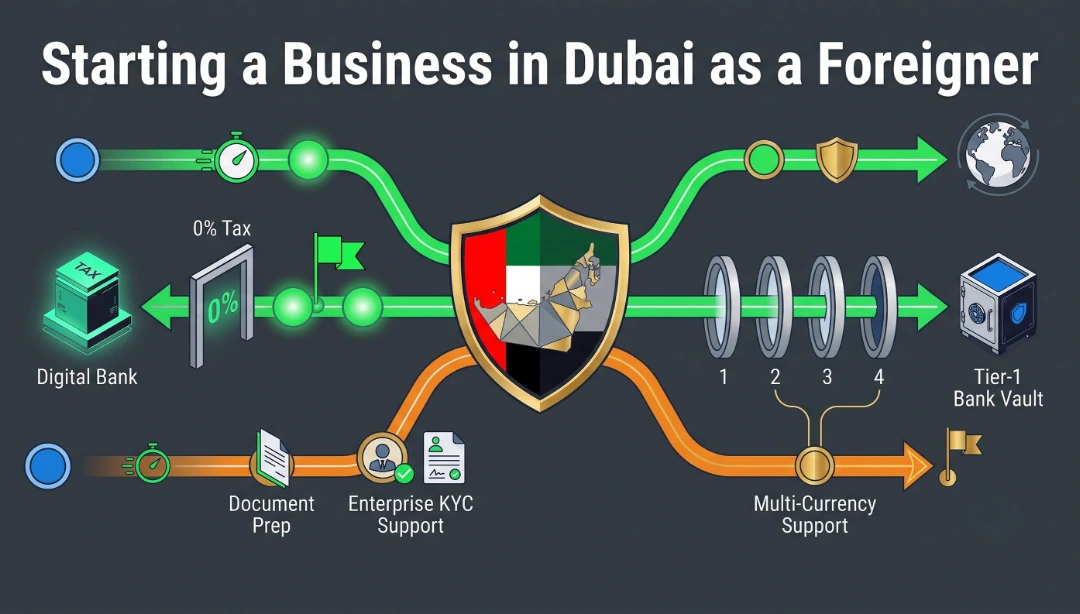
by If you have spent even ten minutes researching how to start a business in Dubai as a foreigner, you have probably run into two completely different stories. One says it takes fifteen minutes and a laptop. The other says you will spend a month chasing paperwork and still not have a working bank account. Both are true, depending entirely on the choices you make in the first week.
This guide strips out the marketing gloss and the horror stories and gives you the actual decision points that determine whether your Dubai company launch takes ten days or ten weeks.
Key Fact: A foreigner setting up in a UAE free zone can now hold 100% of company shares with zero requirement for a local Emirati sponsor, a change that has fundamentally reshaped who can realistically build a company in Dubai from outside the country.
Why Foreigners Keep Choosing Dubai Over Everywhere Else
Every founder asks the same underlying question before they touch a single form: is this actually worth it compared to Singapore, Delaware, or staying put? The honest answer is that Dubai wins on a specific combination of factors that rarely show up together anywhere else.
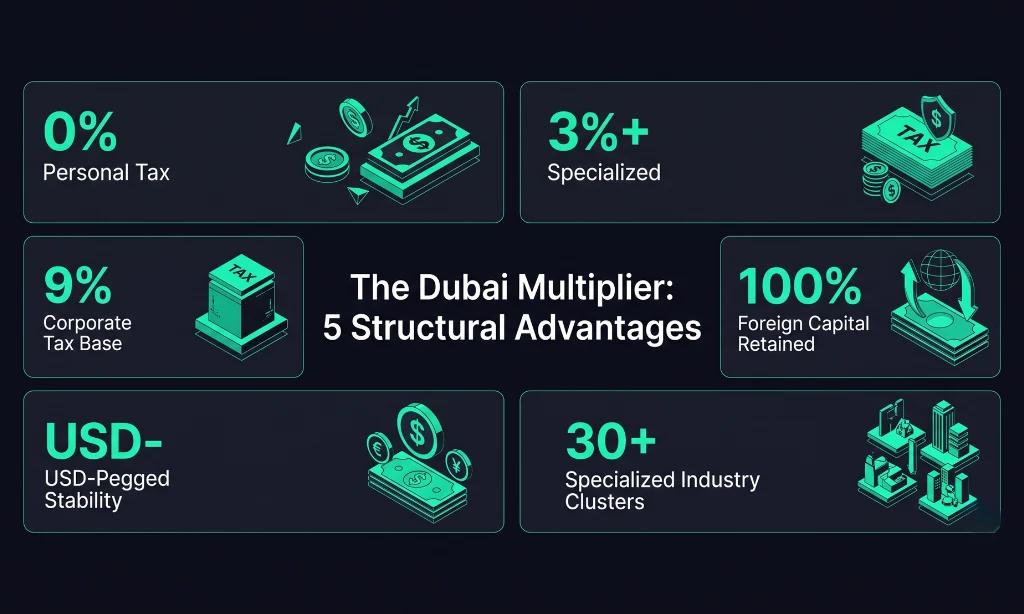
- Zero personal income tax, regardless of how much your company earns
- 100% foreign ownership in the vast majority of business activities, mainland and free zone alike
- A corporate tax rate of just 9%, and only on profits above AED 375,000, with qualifying free zone companies able to keep a 0% rate on qualifying income
- Full repatriation of capital and profits, so nothing gets trapped in the country
- A currency pegged to the US dollar, which removes a layer of financial planning risk that founders in many other hubs have to manage constantly
- 45+ free zones nationwide, with Dubai alone home to more than 30 of them, each one built around a specific industry cluster, from commodities trading to media to fintech
To put the momentum in perspective: foreign direct investment into the UAE reached USD 45.6 billion in 2024, a jump of roughly 48% year on year according to UNCTAD’s World Investment Report, and the country recorded a net inflow of around 6,700 high-net-worth individuals through migration that same year. Those are two separate data points, capital flow and personal migration, but they point in the same direction: a market actively pulling in both money and founders rather than one that is cooling down.
The First Real Decision: Mainland, Free Zone, or Offshore
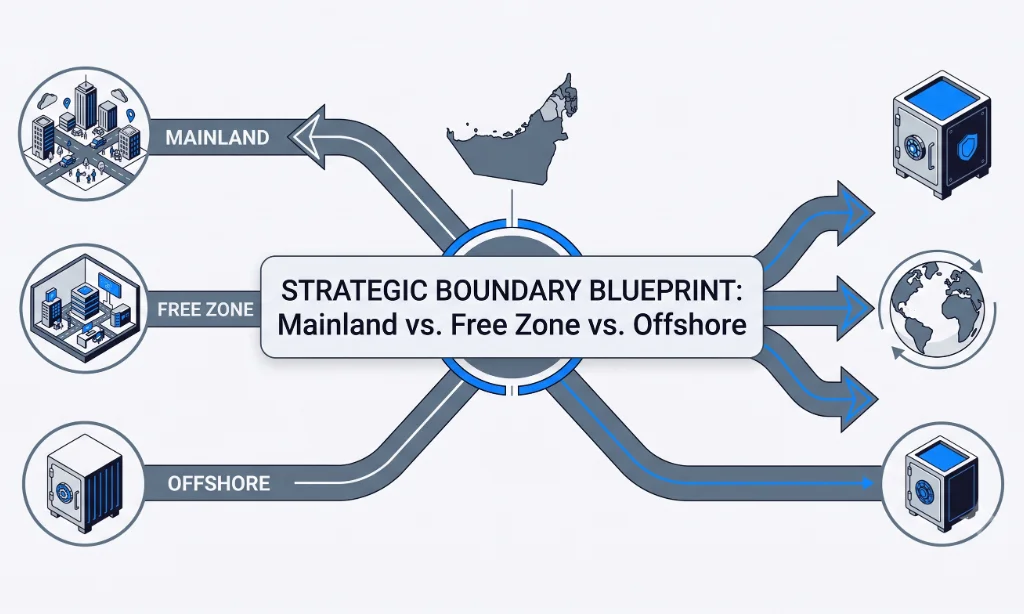
This is the single choice that shapes everything downstream: your cost, your tax exposure, where you can legally sell, and how fast your paperwork moves. Get this wrong and you either pay for a license you cannot use, or you end up needing a second one within a year.
The Three Jurisdictions, Side by Side
| Factor | Mainland | Free Zone | Offshore |
| Foreign ownership | Up to 100% for most activities, some strategic sectors still require an Emirati partner | Up to 100%, no sponsor required | Up to 100%, but no UAE trading rights at all |
| Where you can trade | Anywhere in the UAE and internationally | Internationally, or within the UAE only through a local distributor | Outside the UAE only |
| Physical office | Mandatory, minimum 200 sq ft, no virtual offices allowed | Optional in many zones, flexi-desks and virtual offices accepted | Not permitted inside the UAE |
| Corporate tax | 9% above AED 375,000 profit | 0% on qualifying income if you meet Qualifying Free Zone Person conditions, otherwise 9% | Generally not applicable since there is no UAE-sourced income |
| Regulator | Department of Economy and Tourism (DET) | The specific free zone authority (DMCC, Meydan, IFZA, and so on) | The free zone’s offshore registrar |
| Typical setup cost | Higher, roughly AED 35,000 to 60,000+ | Lower, roughly AED 12,000 to 35,000+ | Lowest, since there is no office requirement |
| Best suited for | Retail, restaurants, construction, government contracts, anything needing a local UAE customer base | SaaS, e-commerce, consulting, holding companies, anything trading internationally | Asset holding, international structuring, privacy-focused entities |
A Simple Way to Decide
Use this quick filter before you talk to a single consultant:
- If your revenue comes from UAE-based clients who need you to invoice them directly and you want the freedom to open a shop or office anywhere in the country → go Mainland. Explore the complete cost of mainland business setup in the UAE.
- If your business is digital, remote, or sells internationally and you have no need to walk into a UAE customer’s office → go Free Zone. This is where the vast majority of foreign solo founders and SaaS businesses land, and it matches what most recent founder accounts describe as the simplest path.
- If you only need a legal entity for holding assets, IP, or shares and have no operational presence in the UAE at all → Offshore is the leanest option, though banking access is more restricted.
One nuance that a lot of generic guides skip: free zone companies are not actually locked out of the UAE mainland market entirely, they just cannot sell there directly. You can still reach mainland customers through a local distributor or by setting up a branch later, so choosing a free zone first does not permanently close that door.
The 0% Corporate Tax Rate Is Conditional, Not Automatic
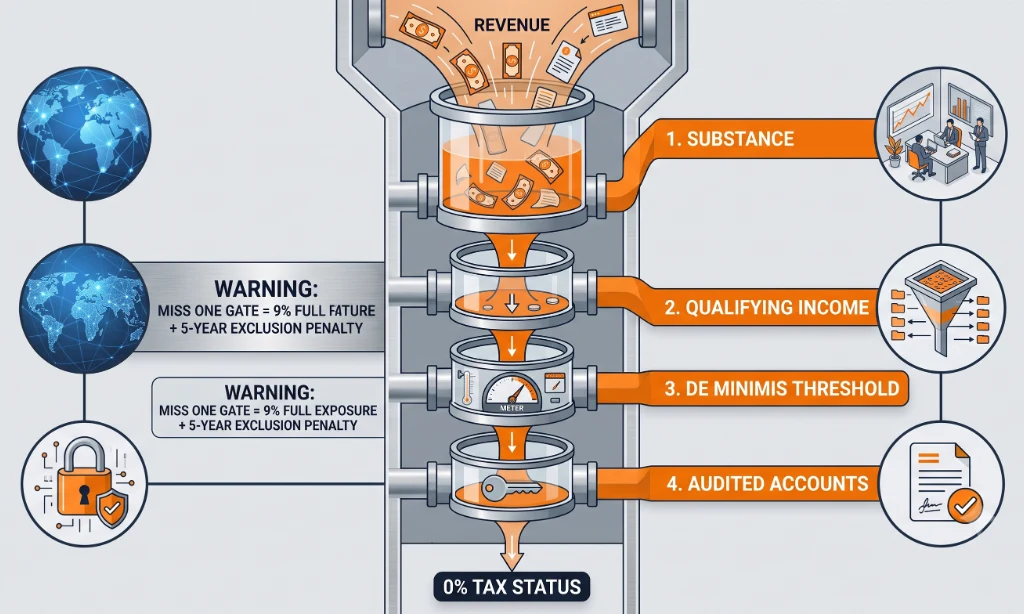
This is the part most marketing pages gloss over, and it is the single biggest source of confusion for new founders. Holding a free zone license does not hand you 0% corporate tax by default. To actually keep that rate on your qualifying income as a Qualifying Free Zone Person (QFZP), under Cabinet Decision No. 100 of 2023 your company must meet all of the following at once:
- Maintain adequate substance in the UAE, meaning a real office, adequate operating expenses, and enough qualified staff for what the business does, not just a mailbox
- Earn income that is classified as qualifying income under Ministerial Decision No. 265 of 2023, generally transactions with other free zone persons or specific qualifying activities
- Keep non-qualifying revenue under the de minimis threshold, which is the lower of AED 5 million or 5% of total revenue. Cross that line and the entire year’s income, not just the excess, gets taxed at the standard 9%
- Prepare audited financial statements, which is mandatory for QFZP status regardless of company size
- Not have elected to be taxed at the standard rate
Key Fact: Every free zone company must register for corporate tax through the EmaraTax portal, even if it expects to owe nothing. Skipping registration on the assumption that a free zone automatically means tax-exempt triggers a flat AED 10,000 late-registration penalty, and this catches a genuinely large number of first-time founders off guard.
The 8-Step Setup Sequence That Actually Works
Strip away the jargon and the entire process for starting a business in Dubai as a foreigner comes down to eight sequential steps. Skipping the order, especially jumping to office leasing before your activity is confirmed, is the single most common cause of delay founders report.
- Lock down your business activity. The UAE activity registry lists over 2,000 recognised activities. Pick 3 to 5 related ones upfront rather than just one, because amending your license later to add an activity usually costs more than including it from day one.
- Reserve your trade name. Submit two or three name options since your first choice may already be taken. Names cannot reference religion, politics, or anything offensive, and if you want to use a person’s name, that person must be a genuine partner or owner, full name only, no initials.
- Apply for initial approval. This is the government confirming it has no objection to you starting this specific business. You will typically submit a passport copy, a short business plan, and basic KYC documents.
- Draft and notarize your legal documents. This means your Memorandum of Association (MOA) or Articles of Association, which spell out ownership percentages and company structure.
- Secure your address. Mainland companies must register a commercial lease through the Ejari system and it must be a real, physical space. Free zone companies often have far more flexibility, including flexi-desks or fully virtual office packages.
- Pay government fees and collect your trade license. Once this is issued, your company legally exists.
- Apply for your Establishment Card and residency visa. Your license makes you eligible for an Investor Visa. This step includes a brief medical fitness test and biometrics, after which you receive your Emirates ID.
- Open your corporate bank account. With your license, MOA, and Emirates ID in hand, you can apply at a traditional UAE bank or a digital-first business bank.
Learn how to renew your Dubai trade license and stay compliant after business registration.
Realistic Timeline: What Founders Actually Experience
There is a wide gap between the fastest possible path and what typically happens, and most guides only show you one end of it.
| Stage | Fastest reported | Typical reported |
| Trade name and initial approval | Same day, some free zones process this online instantly | 2 to 4 days |
| License issuance | As little as 60 minutes through instant-license free zone products | 4 to 7 days |
| Medical test and biometrics for Emirates ID | Under 10 minutes combined, results within 3 hours for the medical | 1 to 2 days |
| Emirates ID delivery | Within 36 hours by post | 3 to 7 days |
| Corporate bank account opening | Under 24 hours with a digital-first bank | 3 to 10 business days with a traditional bank |
| Total, start to operational bank account | Under 2 weeks | 3 to 4 weeks |
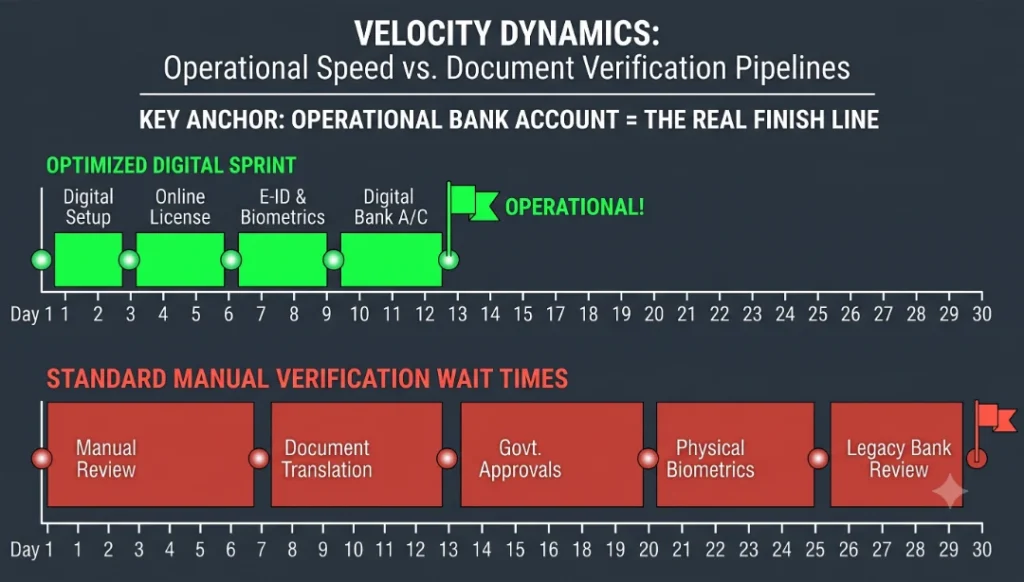
Key Fact: The gap between the fastest and typical timeline almost always comes down to one thing, document accuracy on the first submission. Founders who report the fastest turnarounds consistently mention having every document, signature, and translation correct before their first filing.
Understanding the License Types (Pick the Right One or Pay Twice)
The Department of Economic Development issues six main license categories, though in practice most foreign founders only ever need one of the first three.
| License Type | Who It’s For | Examples |
| Commercial | Trading, buying and selling goods | Import/export, retail, logistics, real estate |
| Professional | Service-based work and expertise | Consulting, IT services, legal advisory, design |
| Industrial | Manufacturing and production | Textiles, metal fabrication, packaging |
| Tourism | Travel and hospitality | Travel agencies, hotels, tour operators |
| Agricultural | Farming and related trade | Nurseries, agri-consultancy, fertiliser trading |
| Crafts | Hands-on specialised trades | Carpentry, printing, blacksmithing |
If you are running a SaaS product, a consultancy, or almost any online-first business, you are almost certainly looking at a Professional license inside a free zone, and that combination is exactly what a growing share of recent foreign founders report choosing because it matches the low-friction, remote-first way they actually operate.
What It Actually Costs (Beyond the Headline License Fee)
The number quoted in most marketing pages is only the license fee. Your real all-in cost stacks several layers on top of it, and the gap between the cheapest advertised price and what founders actually pay in year one is usually bigger than expected.
- License fee: budget-friendly Dubai free zones start around AED 5,750 to 12,900 for a basic license with no dedicated office, climbing well past AED 35,000 to 60,000+ for mainland setups depending on activity and office requirements
- Office or flexi-desk fee: often bundled into free zone packages, a separate and mandatory lease cost for mainland companies
- Visa costs: roughly AED 3,500 to 5,000 per visa, covering the investor visa and any employee visas you sponsor
- Medical test, Emirates ID, and insurance: a smaller but real per-person cost, typically AED 970 to 2,600 combined
- Bank account minimum balance requirements: varies significantly by bank, digital-first banks tend to have lower thresholds than legacy institutions
Key Fact: A realistic first-year total for a solo founder on a lean free zone license (license, one visa, insurance, Emirates ID) tends to land around AED 10,000 to 15,000, not the bare AED 5,750 to 12,500 headline figure many free zones advertise. Always ask for the all-in first-year quote, not just the license price, before comparing zones.
Contextual Contrast: Most comparisons stop at the license price and call free zones “cheap.” What they miss is that a mainland company skips the local distributor requirement entirely, which can matter more than the setup fee difference if your entire revenue model depends on direct UAE customers. Cheapest on paper is not always cheapest in practice once you factor in what a free zone company has to pay a distributor to reach the same market.
The Banking Reality Nobody’s Marketing Page Mentions
This is where the gap between promise and experience is widest, and it is worth addressing directly because it is the step that trips up the most founders.
Opening a UAE corporate bank account can be the slowest part of the entire journey, not because of red tape exactly, but because of strict Anti-Money Laundering (AML) and Know Your Customer (KYC) checks that traditional banks apply heavily to new foreign-owned entities. Compare that to founders who describe the rest of the process, from license to Emirates ID, moving in a matter of days.
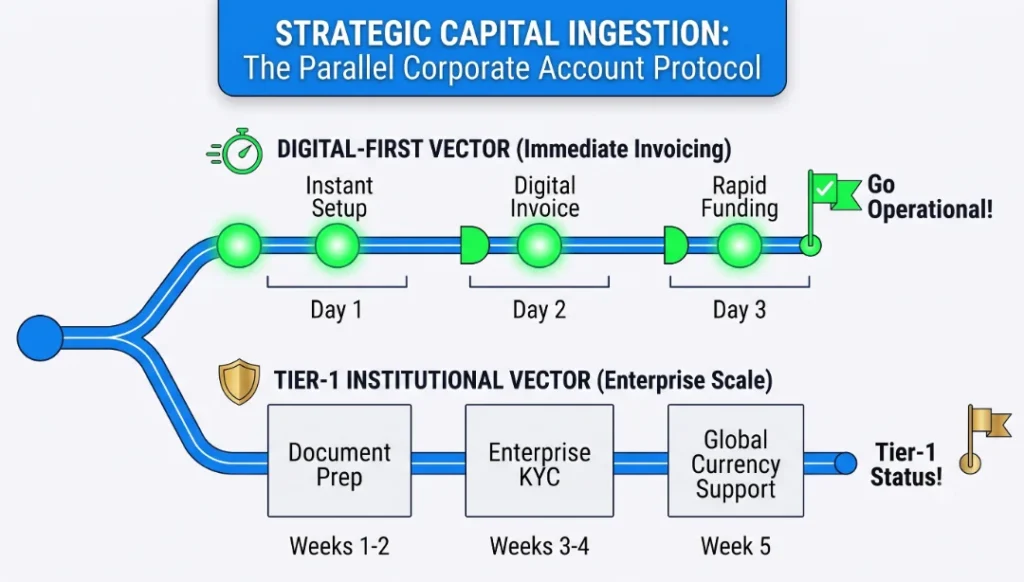
A practical pattern that has emerged among founders setting up in Dubai as a foreigner:
- Start with a digital-first business bank (this is where accounts have reportedly opened in under 24 hours once documents were digitally submitted) to get operational immediately.
- Apply to a traditional bank like Emirates NBD or HSBC in parallel or shortly after, since these institutions typically offer stronger long-term banking relationships, better multi-currency handling at scale, and features some digital banks lack.
- Keep every document, license copy, MOA, and proof of address digitised and ready before you approach any bank, since incomplete submissions are the single biggest cause of delay.
If/Then Banking Decision Matrix:
| If your priority is… | Then choose… |
| Speed, you need to start invoicing this week | A digital-first business bank |
| Long-term credibility with large enterprise clients | A traditional bank like HSBC, Citibank, or Emirates NBD |
| Direct payment integrations (Stripe and similar) | A digital-first bank, several offer native integrations through their banking apps |
| Holding multiple currencies without restriction | Either, but confirm multi-currency account support before signing |
Do You Actually Have to Live in Dubai?
No, and this is one of the most misunderstood parts of the entire process. You can legally own and run a UAE company while living somewhere else entirely. But there is an important distinction founders frequently blur together:
- Owning the company requires nothing about where you live.
- Keeping your residency visa active typically requires re-entering the UAE periodically, commonly at least once every six months, depending on your visa type.
- Claiming UAE tax residency is where most guides oversimplify. Under Cabinet Decision No. 85 of 2022, you have more than one route, and the 183-day rule is only the most commonly cited one.
There are actually three separate routes to UAE tax residency, and you only need to satisfy one:
- 183-day physical presence. Spend 183 days or more in the UAE within any consecutive 12-month period, no other conditions attached. This is the route recognised most consistently under international tax treaties.
- 90-day conditional route. If you hold a valid UAE residence permit (or are a UAE or GCC national) and either maintain a permanent home in the UAE or carry on employment or business there, just 90 days of physical presence in a rolling 12-month window is enough for domestic UAE tax residency.
- Centre of interests test. A more subjective route based on where your usual place of residence and the centre of your financial and personal life genuinely sit, assessed case by case.
The catch worth knowing: domestic UAE tax residency and a UAE Tax Residency Certificate valid for claiming benefits under a double tax treaty with another country are not automatically the same thing. For most treaty purposes, the FTA still applies the 183-day standard, even if you qualified for domestic residency through the 90-day route. If your goal is specifically to stop your home country taxing your worldwide income under a tax treaty, confirm which threshold your specific treaty and situation actually requires, ideally with a tax advisor in your home country, since this is exactly the kind of detail that gets misapplied.
Also worth noting: a Golden Visa or any other long-term UAE residence visa gives you the right to live in the country, but it does not automatically make you a UAE tax resident. Tax residency is a separate legal test you still have to satisfy on its own terms.
Emiratisation: The Requirement Mainland Founders Often Miss
If you are setting up on the mainland and plan to build a real team, there is a workforce quota that free zone founders largely do not have to think about, and the target has escalated significantly since it was introduced.
- Mainland companies with 50 or more skilled employees must raise their Emirati headcount by 2 percentage points every year, split into two 1% checkpoints at mid-year and year-end. The target started at 2% in 2023 and reaches a cumulative 10% by the end of 2026.
- Mainland companies with 20 to 49 employees in a defined list of sectors face a fixed headcount requirement rather than a percentage, generally at least one to two Emirati employees depending on the year.
- As of January 2026, Emirati employees counted toward the quota must be paid a minimum monthly wage of AED 6,000, and companies that missed prior targets have faced financial contributions running into six figures in AED.
Free zone companies are currently exempt from these mandatory MoHRE quotas, which is another reason solo founders and small remote teams gravitate toward free zone structures rather than mainland ones. That said, this exemption is a policy position rather than a permanent statutory guarantee, and it is worth confirming current status with your free zone authority before assuming it will hold indefinitely.
Common Mistakes Foreign Founders Actually Report
Pulled directly from real founder experiences, not textbook advice:
- Choosing a business activity list that’s too narrow. Adding activities later costs more than including a realistic range from the start.
- Not getting documents professionally translated and notarized. Anything not in English needs a legally certified translation, done by an authorized translator, not a casual bilingual friend.
- Signing agreements you don’t fully understand, particularly around local sponsorship arrangements on older-style mainland structures. If a sponsorship or partnership agreement exists, make sure it is formally attested by the relevant court, not just a private handshake document.
- Assuming the license is the finish line. In reality, the license is the starting point. Banking, visa processing, and ongoing compliance (VAT filing, corporate tax registration, annual trade license renewal) are what actually determine whether the business runs smoothly month to month.
- Skipping a background check on local hires or partners. This applies specifically to anyone you are bringing on as staff or as a nominee/sponsor in older-style arrangements.
Frequently Asked Questions
Not necessarily for every free zone. Many free zones now offer a fully digital registration process. Mainland companies and certain regulated activities may still require an in-person visit at some stage, particularly for biometrics and the Emirates ID.
Realistically, budget 2 to 4 weeks for a standard free zone setup, and closer to 4 to 6 weeks for mainland or regulated activities. The fastest documented cases have gone from license to working bank account in under two weeks, but that requires clean documentation from the very first submission.
For free zone companies, no. Reforms now allow up to 100% foreign ownership without any Emirati sponsor in the vast majority of free zone activities. For certain mainland activities in strategic or regulated sectors, a local partner or service agent may still be required, so this should be confirmed against your specific business activity before you commit to a structure.
The UAE applies a 9% corporate tax on profits exceeding AED 375,000, with the first AED 375,000 taxed at 0% for every business, mainland or free zone. Free zone companies that meet all five Qualifying Free Zone Person conditions, adequate substance, qualifying income, audited financials, transfer pricing compliance, and staying under the de minimis threshold, can maintain a 0% rate specifically on qualifying income, while non-qualifying income is still taxed at 9%. Every free zone company must still register for corporate tax regardless of whether it expects to owe anything. A 5% VAT applies separately on most goods and services, with mandatory registration above AED 375,000 in taxable supplies.
Yes, for ownership and day-to-day operations. You will still need to re-enter the UAE periodically to keep a residency visa active, and if you want to claim personal UAE tax residency, you generally need to spend at least 183 days a year physically in the country.
The Bottom Line
Starting a business in Dubai as a foreigner in 2026 is genuinely more accessible than it has ever been, largely because the sponsor requirement that used to gate foreign ownership has been rolled back across most free zone and many mainland activities. But “accessible” does not mean “automatic.” The founders who move through this fastest are the ones who pick their jurisdiction based on where their actual customers are, prepare clean documentation before their first submission, and treat the trade license as the beginning of the operational work rather than the end of it.
If you want such more helpful information, explore Simply DXB about business in Dubai.




Thank you for sharing this — it’s genuinely helpful, and clearer than most of the articles I’ve read on starting a business in Dubai as a foreigner.