 by
by If you are trying to figure out how to renew a trade license in Dubai without wasting a trip or a week, this guide walks you through exactly what you need: the documents, the fees, the deadlines, and the differences between a mainland and free zone renewal. Most owners do not lose their license because they forgot the rules. They lose it because the renewal timeline quietly overlaps with something else, a tenancy contract that is about to lapse, an approval that expired months ago, or a fine that never got cleared.
What Renewing a Trade License in Dubai Actually Involves
Renewing your Dubai trade license means proving to your regulator, either the Department of Economy and Tourism (DET) for mainland companies or your Free Zone authority, that your business premises, ownership details, and regulatory approvals are still valid, and then paying the applicable government fee for another 12 month cycle.
Three things decide whether your renewal goes smoothly:
- Your Ejari (tenancy registration) is active and has enough validity left
- Every partner, shareholder, and activity on file is accurately reflected
- Any outstanding fine or dues balance is cleared before you submit
Get those three right and the rest of the process is largely administrative.
Planning a new venture? Learn the complete process of starting a business in Dubai as a foreigner.
Why This Deadline Deserves Real Attention
A trade license is not a formality you renew and forget. It is the single document that keeps your invoicing legal, your bank account open, and your team’s visas active. Dubai’s Department of Economy and Tourism treats an expired license as an operational stop order, not a minor lapse, and the same logic applies inside every free zone. Most business owners in Dubai only learn how strict this renewal system is after their trade license has already lapsed, which is exactly the scenario this guide is meant to help you avoid.
The READY Framework: A Faster Way to Prepare Your Renewal
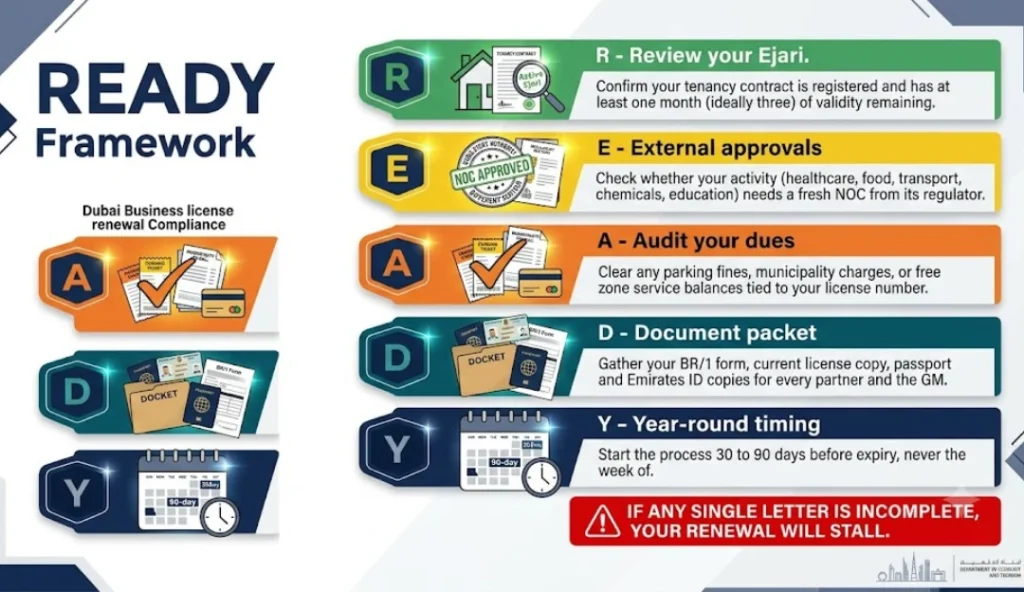
Instead of juggling several scattered checklists, use this five part filter before you touch any application form. It compresses everything Dubai’s regulators, service centers, and the free zones ask for into one memorable sequence, and it works whether your license is mainland or free zone based.
| Letter | What It Stands For | What You Actually Do |
|---|---|---|
| R | Review your Ejari | Confirm your tenancy contract is registered and has at least one month, ideally three, of validity remaining |
| E | External approvals | Check whether your activity (healthcare, food, transport, chemicals, education) needs a fresh NOC from its regulator |
| A | Audit your dues | Clear any parking fines, municipality charges, or free zone service balances tied to your license number |
| D | Document packet | Gather your BR/1 form, current license copy, passport and Emirates ID copies for every partner and the GM |
| Y | Year round timing | Start the process 30 to 90 days before expiry, never the week of |
If any single letter in this framework is incomplete, your renewal will stall, even if every other document is perfect.
Mainland vs Free Zone: How the Renewal Path Differs
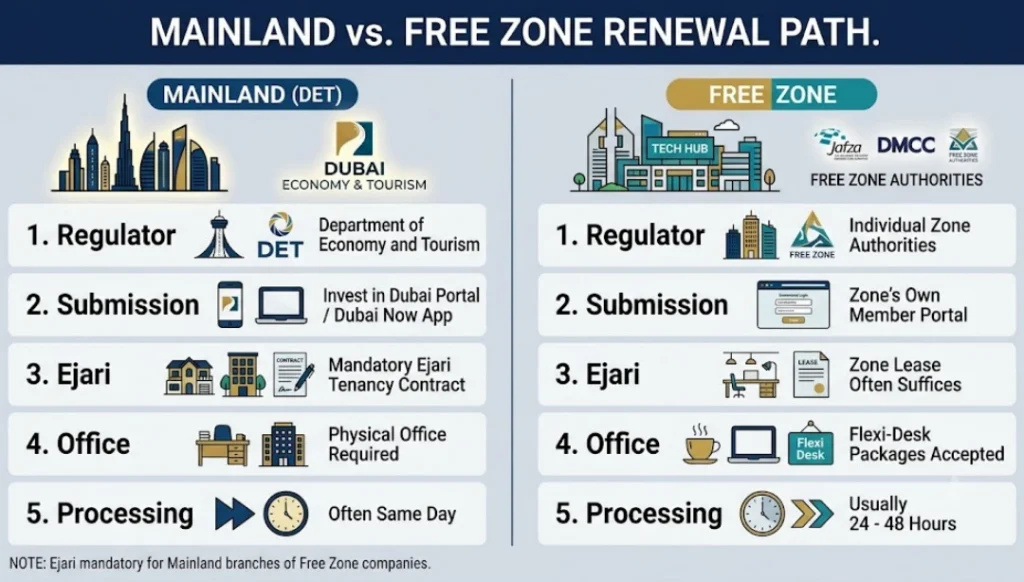
Where your company is registered changes almost everything about the renewal process, from which portal you use to whether you need a physical office at all. How you go about renewing a license in Dubai really comes down to which of these two systems your trade falls under.
| Factor | Mainland (DET regulated) | Free Zone (zone specific authority) |
|---|---|---|
| Regulator | Department of Economy and Tourism | Individual free zone authority (DMCC, IFZA, Meydan, DDA, etc.) |
| Submission channel | Invest in Dubai portal, Dubai Now app, SMS to 6969, or a DET service center | The free zone’s own member portal |
| Ejari requirement | Mandatory, tied directly to the license | Often not required; a free zone lease agreement usually suffices |
| Office requirement | Physical Ejari registered premises generally needed | Flexi desk or virtual packages accepted in many zones (some allow up to four visas without a physical lease) |
| Financial audit | Not required for most basic commercial activities | Frequently mandatory, especially for higher visa quota packages |
| Typical processing time | Often same day once documents are verified | Usually 24 to 48 hours through the digital dashboard |
Good to know: If you operate in a free zone specifically to skip Ejari paperwork, that advantage disappears the moment you also run a mainland branch or an approved onshore activity, since Ejari requirements apply to that portion of the business regardless of your free zone status.
Step by Step: Renewing a Mainland Trade License
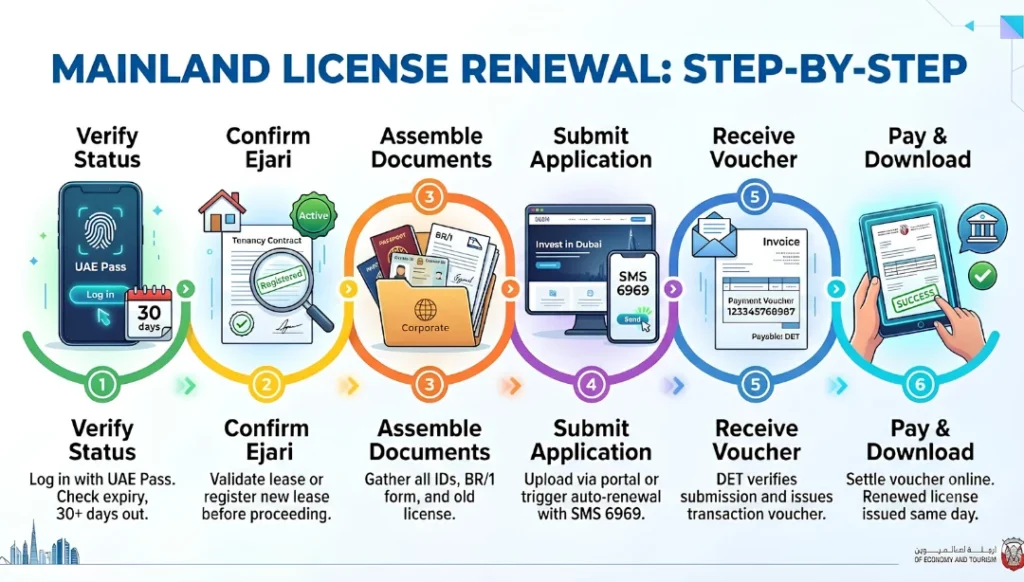
Here is how Dubai’s mainland companies actually move a license through renewal, from status check to final download.
- Verify your license status. Log in to the Invest in Dubai portal or the Dubai Now app using your UAE Pass and check your expiry date, at least 30 days out if possible.
- Confirm your Ejari is current. If your tenancy contract has expired or you have relocated, register the new lease with Ejari before doing anything else. A rejected Ejari check is the number one cause of stalled applications.
- Assemble your document packet. You will need your current license copy, a signed BR/1 renewal form, updated passport and Emirates ID copies for all partners and the general manager, and any external NOC your activity requires.
- Submit your application. Upload everything through the Invest in Dubai portal, or if your Ejari is already linked and your file has no outstanding issues, simply text your license number to 6969 to trigger the SMS auto renewal route.
- Receive your payment voucher. Once DET verifies the submission, it issues a transaction number with the exact fee owed. This voucher is single use and cannot be recycled for a future renewal.
- Pay and download. Settle the voucher online or at an approved bank, and your renewed trade license is issued electronically, often within the same day.
Find out how much it costs to register a mainland company in Dubai.
If/Then Quick Reference for Mainland Renewals
| If your situation is… | Then you should… |
|---|---|
| Your Ejari expires in under 30 days | Renew the tenancy contract first, before submitting anything to DET |
| You are relocating offices | Apply for a short term tenancy contract, or move in first, then renew so the new Ejari reflects the current address |
| Your activity needs a regulator NOC (health, food, transport) | Request the NOC renewal at least two to three weeks before your license expiry |
| You already renewed last year with no changes | Use the SMS route to 6969 for the fastest possible turnaround |
Step by Step: Renewing a Free Zone Trade License
If your trade is registered in a Dubai free zone, renewing a license looks a little different from the mainland process, since each zone runs its own digital ecosystem.
- Log into your zone’s member portal. Every major free zone, from DMCC to Meydan, runs its own dashboard for renewals.
- Upload your current license and lease. Submit your existing trade license along with your updated free zone lease agreement; some zones will also ask for an updated business plan or audited financials.
- Clear your Free Zone dues. If you owe membership fees, Chamber of Commerce fees, or facility charges, settle these first, since an outstanding balance is grounds for an automatic hold.
- Review and pay the renewal quotation. The portal generates a fee based on your package and visa allocation; sign off and pay directly through the dashboard.
- Download your renewed license. Most free zones complete this digitally within 24 to 48 hours of payment confirmation.
Documents You Need, Organized by License Type
| License Type | Core Documents | Additional Requirement |
|---|---|---|
| Commercial License | BR/1 form, current license, passport copies, Ejari or lease | External approval if activity is regulated (chemicals need Dubai Narcotics Department clearance, for example) |
| Professional License | Same core set | Local Service Agent agreement (if applicable) and updated professional body approval |
| Industrial License | Same core set | Civil Defence Approval |
| Tourism and special activities | Same core set | Renewed DTCM approval and, for select activities, valid insurance |
What Renewal Actually Costs
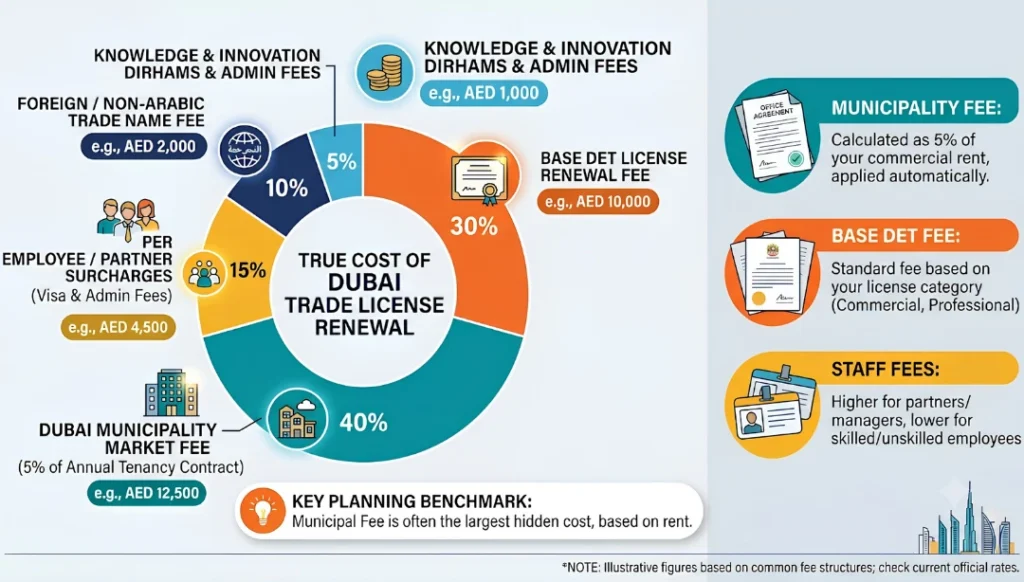
There is no single flat fee for renewing a trade license in Dubai. Your total depends on your license category, your commercial rent, and how many employees and partners are attached to the file. Anyone budgeting for how a trade license gets renewed in Dubai should treat the figures below as a planning benchmark, since fees do get revised periodically, and the fastest way to confirm your exact number is to check your license number on the Invest in Dubai portal before budgeting.
| Cost Component | Typical Range | Notes |
|---|---|---|
| Mainland base renewal | AED 8,000 to AED 25,000 | Varies by activity classification under the Licensing Categories Decision |
| Mainland via a premium corporate service provider (VIP/no queue) | From roughly AED 25,850 | This is a bundled total from full service corporate providers like EGSH, not the government fee alone; it includes the license fee plus their comprehensive service charges |
| Mainland via a standard DET Outsourcing Centre (Zajel, Tas’heel, OnTime) | Base renewal fee plus roughly AED 100 to AED 500 | A walk-in at a standard typing/service centre adds only a minor processing fee on top of the base renewal cost, well below the VIP package price |
| Free zone renewal | AED 7,500 to AED 15,000 | Usually mirrors your original setup cost |
| Dubai Municipality market fee | 5 percent of your annual tenancy contract value | Applies automatically to mainland renewals tied to commercial rent |
| Per employee/partner charge | AED 300 to AED 1,000 | AED 1,000 for managers/partners, AED 600 for skilled staff, AED 300 for unskilled staff (reducible with the employee’s own Ejari and DEWA bill on file) |
| Foreign or non Arabic trade name | AED 2,000 annually | Additional AED 1,000 for each of certain words like “Global” or “World,” capped at AED 3,000 total |
| Knowledge and Innovation Dirham | AED 20 flat | AED 10 each, applied to nearly every DET transaction |
Why this matters: Most owners budget only for the headline license fee and get blindsided by the market fee, the per employee surcharge, and name related charges. Before you pay any voucher, ask for the itemized breakdown and check it line by line, since incorrect charges do occasionally slip in.
A note on service fees: Don’t assume every third party renewal service costs AED 25,000+. That figure applies specifically to full service corporate providers who bundle document handling, compliance checks, and priority processing into one package. If you walk into a standard DET Outsourcing Centre yourself with your documents ready, you are typically only adding a small administrative fee on top of the base government renewal cost, not a premium service charge.
The Grace Period, and Why It Is Not a Safety Net
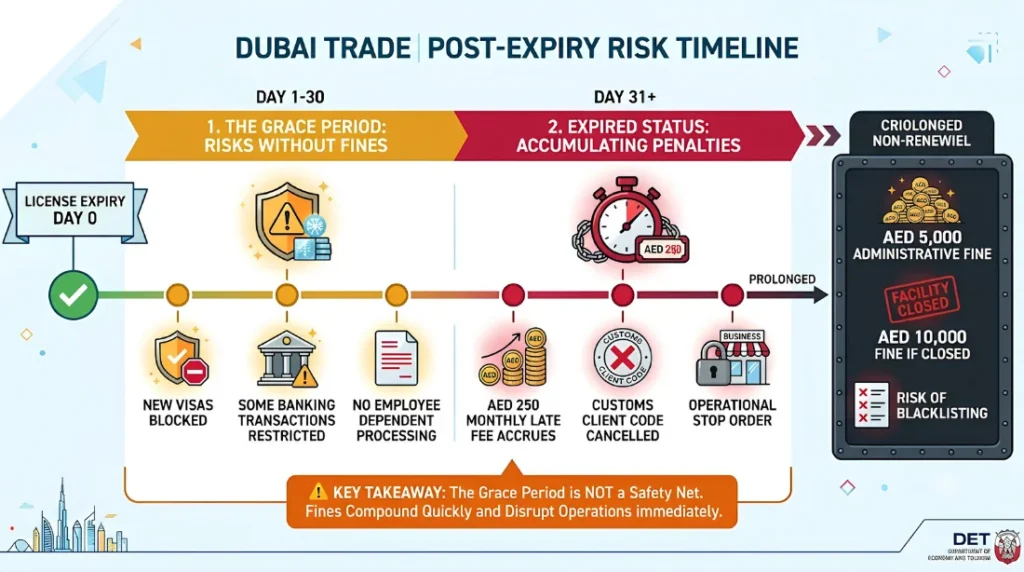
Dubai gives every trade license a 30 day grace period after expiry. During those 30 days you generally will not be hit with the flat administrative fine, but visa processing and some banking transactions can already be flagged or frozen the moment your license record shows as lapsed. This is exactly why so many owners searching for how to renew a trade license in Dubai end up doing it under time pressure instead of on their own schedule.
| Timeframe | What You Can Still Do | What Gets Blocked |
|---|---|---|
| Day 1 to Day 30 (grace period) | Submit your renewal without the flat fine | New visa applications, some banking transactions, employee dependent processing |
| Day 31 onward | Renewal is still possible | AED 250 per month late fee accrues, on top of the license fee |
| Prolonged non renewal | Very limited | AED 5,000 administrative fine, AED 10,000 fine if the facility has been administratively closed, Customs Client Code cancellation, and blacklisting risk |
If you take away one number from this guide, make it this: AED 250 per month compounds fast, and it is layered on top of, not instead of, your normal renewal fee once the grace period closes.
Rules Worth Double Checking Before You Renew
- Free zone companies operating on the mainland. Some free zone companies are permitted to carry out specified activities in mainland Dubai without opening a separate onshore entity, provided the right approvals are in place. If this applies to you, expect mainland style requirements, such as Ejari, to apply to that portion of your business at renewal time.
- Contracting and construction activities. Contractor licenses carry stricter classification and compliance requirements than a standard commercial license. Confirm your classification is current before submitting a renewal.
- Online income and content creation. If you earn income from online content, you may need a trade license along with a Professional Media Permit from the UAE Media Council.
Mistakes That Delay a Trade License Renewal
- Submitting before the Ejari is finalized. A pending or expired Ejari is the fastest way to get your application rejected outright.
- Assuming an expired license can still be amended. It cannot. Any change to a partner, activity, or trade name has to be resolved before or alongside renewal, not after the license has lapsed.
- Forgetting signatory confirmations. If shareholders never completed their signatory or e legal confirmation within the first 12 months of setup, this has to be cleared before any renewed license is released.
- Ignoring sector specific approvals until the last week. Health, food, transport, and chemical businesses routinely underestimate how long external NOC renewals take.
- Treating the payment voucher as final without checking it. A five minute review before paying can save you from covering someone else’s mistake.
Frequently Asked Questions
Most mainland renewals through the Invest in Dubai portal, or through an authorized DET service provider, are completed within one business day once your Ejari and documents are verified. Free zone renewals typically clear within 24 to 48 hours after payment.
You get 30 days after your license expiry date to renew without the flat administrative fine. Banking access and visa processing can still be disrupted during this window, so treat it as a buffer, not a target date.
Generally no. Most free zones use their own lease system instead of Ejari, though some activities or higher visa packages may still ask for supporting tenancy documentation.
Beyond the AED 250 monthly late fee and the AED 5,000 administrative fine for operating on an expired license, you risk your Customs Client Code being cancelled, your corporate bank account frozen, employee visas cancelled, and potential blacklisting by the DET.
Yes, renewal is the most common window for updating your trade name, adding or removing a business activity, changing your local sponsor, or adjusting your registered address, provided the license has not already expired when you submit.
The Bottom Line
Renewing a trade license in Dubai rewards preparation far more than speed. The businesses that sail through their renewal every year checked their Ejari status, cleared their dues, and gathered their documents a full month before the deadline instead of the week of. Build that habit once, and every future renewal becomes routine paperwork rather than a fire drill.
If you want such more helpful information, explore Simply DXB about business in Dubai.