 by
by If you are moving to the Emirates for work, family sponsorship, or investment, the UAE visa medical test is one checkpoint you cannot skip. Every applicant for a UAE residence visa, new or renewal, must pass a government-supervised health screening before the Emirates ID and residency stamp can be issued. This guide walks through every stage of the process: who must be tested, which diseases are screened, what documents to carry, how much it costs, how long results take, and what happens if the outcome is “unfit.” The goal is simple, after reading this, you shouldn’t need to open another tab to understand how UAE medical screening for residency works.
Why the UAE Requires a Medical Fitness Test for Residency
The UAE’s residency system treats public health as a gatekeeping condition, not a formality. Federal health regulations require every expatriate entering the country for work or long-term residence to be certified free of specific communicable diseases before a residence permit is granted. This applies to first-time applicants and to people renewing an existing permit, the government re-checks fitness at every renewal cycle, not just at first entry. In practice, this means your ability to stay in the country legally is tied directly to a clean bill of health from an approved facility, which is why so many people search for a clear walkthrough of the UAE visa medical test before their appointment.
Who Needs to Take the Test (and Who Doesn’t)
Not every visa category triggers a health screening. Here’s the practical breakdown:
- Required: Employment/work visa holders, residence visa holders (including family sponsorship), domestic workers, student visa holders aged 18+, investor visas, retirement visas, and Golden Visa applicants.
- Not required: Tourist visas, visit visas, and transit visas. If you’re only in the country short-term, no health screening applies.
- Partial exemption: Children under 18 skip the HIV blood test but still undergo a simplified blood draw and, in most cases, a chest X-ray.
- GCC nationals: Generally exempt or fast-tracked, since Gulf Cooperation Council residents can often rely on reciprocal health clearances.
One rule trips up a lot of newcomers: the screening cannot be completed before you arrive. It must be done physically inside the UAE, at a facility the health authority has approved, once your entry permit is active, a document from a clinic in your home country will not be accepted by immigration, no matter how thorough it is.
Documents You Need to Bring
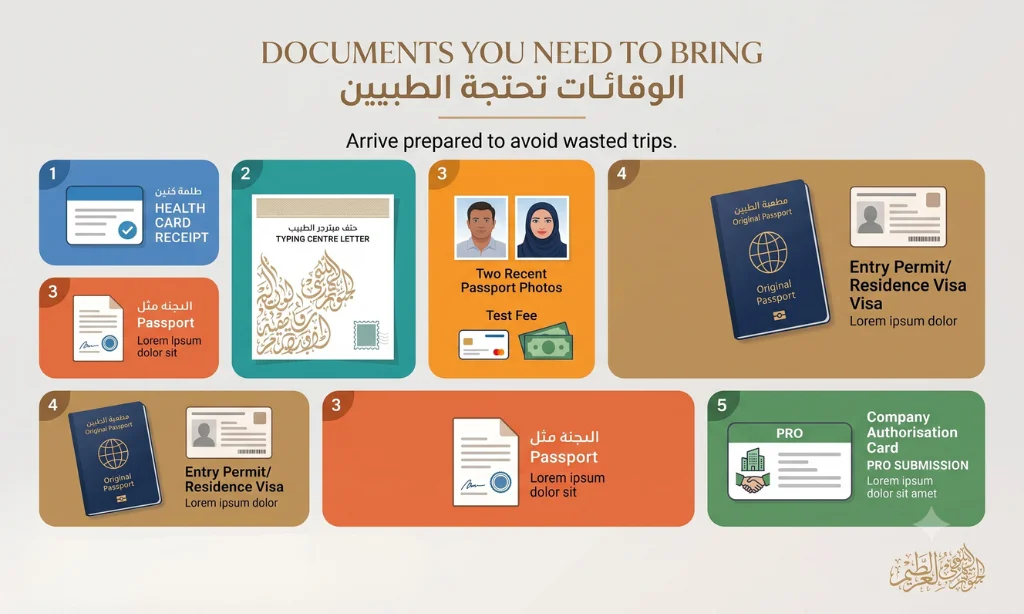
Arrive prepared so a missing paper doesn’t turn a 20-minute visit into a wasted trip:
- Health card receipt or health card number (issued when you first register at the testing system).
- Typing centre letter in Arabic confirming your visa application details.
- Two recent passport-size photographs, plus the test fee in cash or card.
- Original passport, along with a copy of your entry permit or existing residence visa.
- Company authorisation card, if an employer’s PRO is submitting on your behalf as part of a group booking.
Skipping any single item is one of the most common reasons applicants get turned away and have to rebook, so double-check the list the night before.
Step-by-Step: How the Process Actually Works
- Register and book an appointment, either walk in or reserve a slot through the relevant health authority’s official app or online portal for your emirate.
- Check in with your documents and pay the applicable fee at the counter.
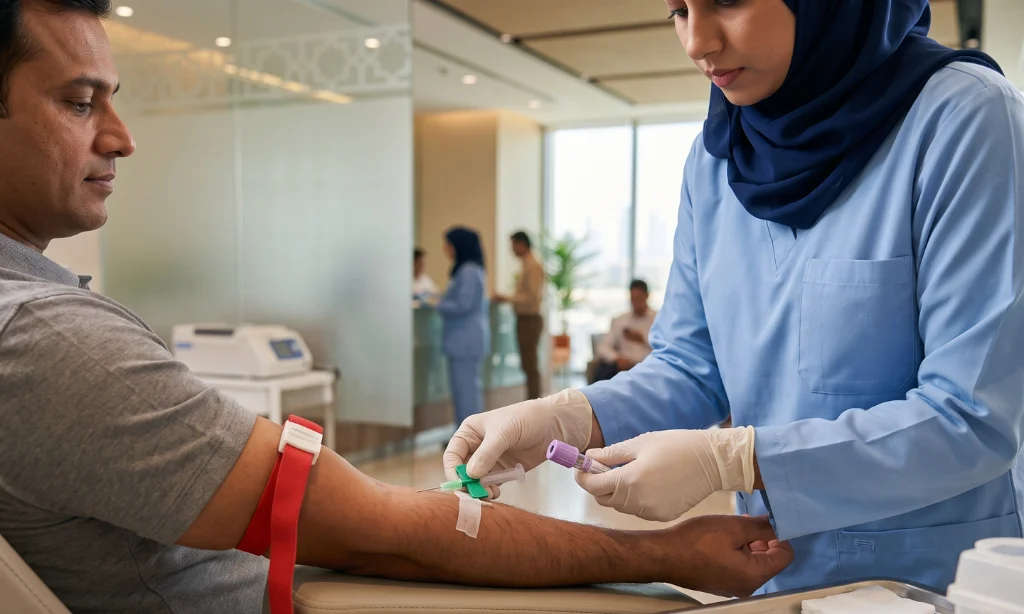
- Blood draw, a lab technician takes a sample to screen for HIV, hepatitis B and C, and syphilis (where relevant to your profession).
- Chest X-ray, this single scan is how tuberculosis is confirmed for every category of worker, since TB is a respiratory infection that a blood test alone won’t reliably catch.
- Physical checkpoint, a quick review of your documents and, for some categories, a brief physical exam.
- Wait for results, turnaround depends on the service tier you choose (see the timeline section below).
- Certificate transmission, once you’re cleared, the fitness certificate is sent electronically straight to the immigration system; you don’t need to carry a paper copy to any office.
From walking in to walking out, the entire physical visit, registration, blood draw, and X-ray combined, usually takes between 10 and 45 minutes, depending on how busy the centre is and whether you’ve chosen a premium “smart” facility. In other words, the appointment itself is short; it’s the paperwork beforehand that trips people up.
What Gets Tested: The Full Screening Panel
The standard panel that applies to nearly every applicant covers:
- HIV/AIDS
- Tuberculosis (via chest X-ray, since it’s a respiratory condition)
- Hepatitis B and Hepatitis C
- Leprosy
- Syphilis, required for domestic workers, salon staff, healthcare workers, and other high-contact professions
- Pregnancy test, required for female domestic workers specifically, not for the general applicant pool
- Hepatitis A, screened for select occupational categories
Certain professions face a longer checklist. Domestic workers, nursery staff, food handlers, salon and health-club employees, and healthcare workers are held to a stricter standard: alongside the standard panel, they must also clear syphilis screening, and those in healthcare, education, or domestic-work roles are increasingly expected to show proof of Hepatitis B vaccination as part of tightening occupational health requirements. If any transmissible disease is suspected, the blood test is what confirms it, the same blood sample that screens for HIV is the one that flags most other communicable conditions on the list.
Where to Go: Approved Centres by Emirate
Only government-approved facilities count, a private clinic result, however professional, won’t be accepted for visa purposes.
- Dubai: Dubai Health operates a wide network of medical fitness centres across the emirate, including several premium locations built specifically to offer faster, more comfortable service. These centres are digitally connected straight through to immigration, which is why results never need to be carried in on paper.
- Abu Dhabi: Screenings run through SEHA’s Disease Prevention & Screening Centres, spread across Abu Dhabi Island, Al Ain, Mussafah, Baniyas, and other areas.
- Sharjah and the Northern Emirates: Emirates Health Services (EHS) operates the approved centres, following the same federal panel and rules.
Most standard branches close on weekends, though a few extended-hours locations and the premium centres stay open Friday and Saturday to absorb demand, worth checking before you plan a weekend trip specifically for this.
Fees: What the UAE Medical Test Actually Costs
Pricing varies by emirate, applicant category, and how fast you want the result, but here’s a realistic 2026 range:
| Item | Approximate Cost (AED) |
|---|---|
| Standard screening package | 250–500 |
| Basic blood panel only | 200–300 |
| HIV and hepatitis screening | 100–200 |
| Chest X-ray | 150–250 |
| Domestic worker / high-risk category package | 350–700 |
| Express/fast-track processing surcharge | 50–100 |
| Golden Visa medical fee | Around 700 |
For salaried employees, the employer or sponsor typically covers this fee as part of onboarding; freelancers, investors, and retirement-visa holders pay it themselves. It’s worth noting the fee is treated as a government administrative charge rather than a medical service, so standard health insurance usually doesn’t reimburse it.
How Long Results Take, and How Long the Certificate Lasts
Processing speed comes in tiers, and choosing the right one matters if your entry permit is close to expiring:
- Standard processing: 3–5 working days
- Fast-track: roughly 48 hours
- Urgent: within 24 hours
- VIP / premium smart centres: same-day, sometimes in as little as 10–30 minutes
You’ll get an SMS and email once the result posts, there’s no paper certificate to collect in person, since it’s transmitted electronically straight into the immigration pipeline. Once issued, the certificate itself is only valid for a limited window: typically around 90 days for standard residence visas, but a tighter 30 days for Golden Visa applicants, so timing your visa stamping appointment around it matters. If your entry permit is nearing its deadline, the 24-hour urgent tier is generally the safer choice to avoid an overstay situation altogether.
What Happens If You Fail: The Unfit Outcome
This is the part every applicant worries about, so here’s exactly how it plays out:
- HIV/AIDS positive: Under current rules, both new and renewal applicants who test positive face immediate deportation, this is applied consistently regardless of how long someone has already lived in the country.
- Active tuberculosis: Some applicants aren’t deported outright; instead, they may be issued a conditional one-year certificate tied to a supervised treatment course, after which they’re reassessed.
- Hepatitis, syphilis, or leprosy positive: Typically results in a rejected or cancelled visa application, sometimes with an option to appeal or retest depending on the specific health authority’s assessment.
- General unfit notification: If you’re found unfit for any listed condition, you’re usually given a set window, commonly around 30 days, to arrange departure, unless a treatment or appeals pathway applies to your specific case.
There genuinely is a formal appeal and re-examination process at facilities like DHA, so an initial “unfit” result isn’t always the final word, but it moves fast, and the clock starts the moment the result posts.
Special Notes for Domestic Workers, Golden Visa Holders, and Families
- Domestic workers (housemaids, nannies, private drivers) face the widest test panel, the standard list plus syphilis and, for women, a pregnancy test, because these roles involve close daily contact with a household.
- Golden Visa holders go through the identical screening as any other residency applicant; there’s no shortcut version. The only real difference is the shorter 30-day certificate validity window mentioned above, so timing the test close to your Emirates ID appointment is more important for this group than for a standard 2–3 year visa holder.
- Family sponsorship (spouses, children) follows the same rules as the primary applicant, with the under-18 HIV exemption being the main variation.
Practical Tips From People Who’ve Actually Done This
- No fasting is required for the standard visa blood panel, you can eat normally beforehand, though light meals and good hydration make the visit smoother.
- Dress modestly. Shoulders and knees should be covered, particularly for women, out of respect for local norms at government facilities.
- Bring your documents in a folder, not loose in a bag, queues move fast at busy centres and staff won’t wait while you dig through a backpack.
- Book early in the morning if you want to avoid the longest queues, especially at general (non-premium) branches in Dubai and Abu Dhabi.
- Track your result digitally through the relevant health authority’s app rather than calling the centre, status updates typically appear there well before anyone answers the phone.
Frequently Asked Questions
Can I do the medical test outside the UAE before I arrive?
No. With the narrow exception of some GCC nationals using reciprocal certificates, testing must happen physically inside the UAE at an approved centre, generally within 60 days of entry.
Do tourists or visit-visa holders need this test?
No, the requirement only applies to long-term residence, employment, and student visa categories.
Is the medical fee covered by health insurance?
Generally no. It’s classified as a government administrative fee rather than a clinical service, so most policies don’t reimburse it.
What if my result is inconclusive?
Centres typically offer a retest at an additional charge before issuing a final fit/unfit determination.
Does a positive result always mean deportation?
Not always. HIV-positive results trigger deportation for both new and renewal applicants. Other conditions, like latent TB, may instead lead to a conditional certificate and a supervised treatment period rather than immediate removal.
Final Thoughts
The UAE visa medical test is a short appointment with long consequences attached to it, get the documents right, pick a processing tier that matches your entry-permit deadline, and know in advance which category of tests apply to your specific visa type. Whether you’re relocating for a new job, renewing an existing residence permit, or bringing your family over on a sponsored visa, treating this health screening as seriously as the visa application itself is what keeps the rest of your UAE relocation on schedule.